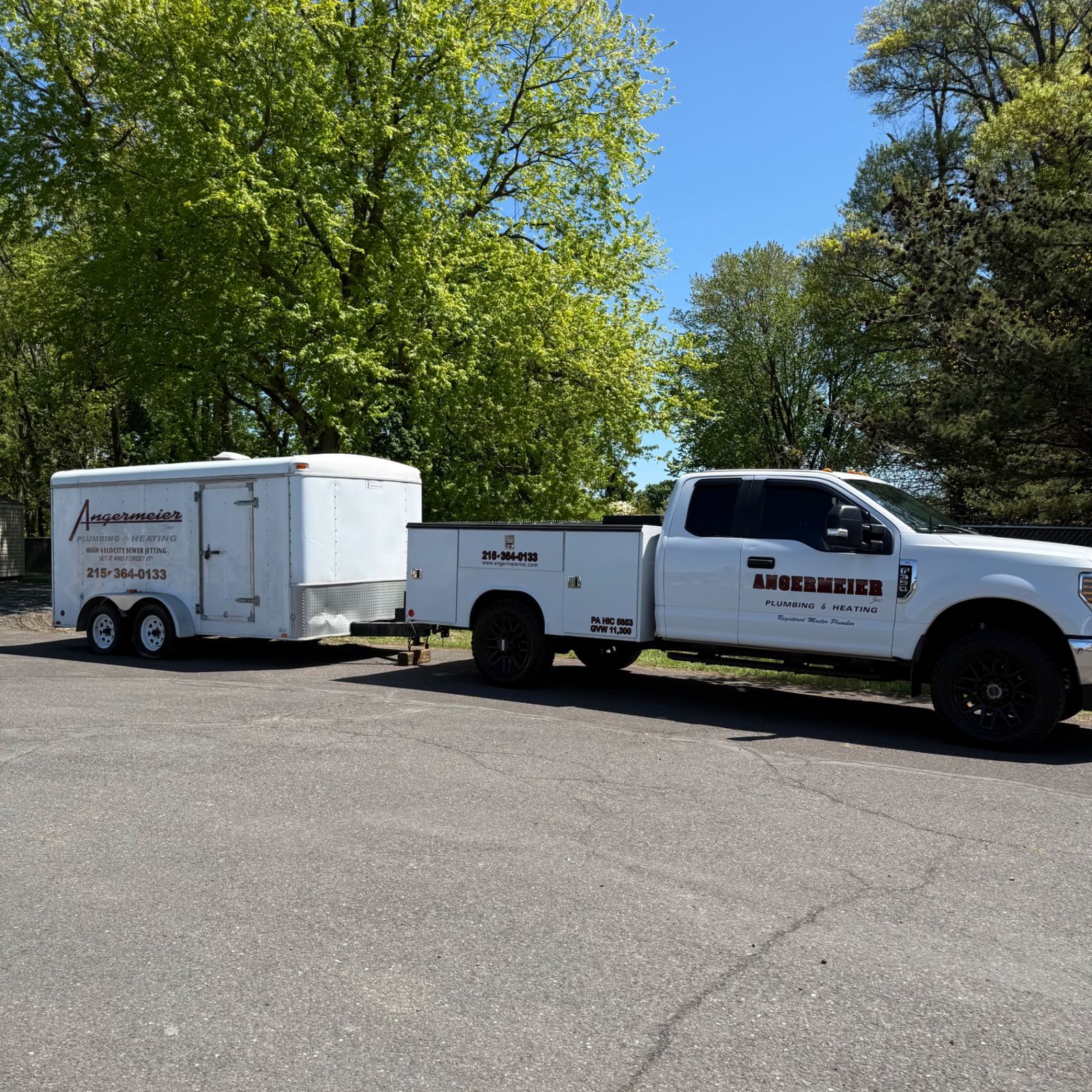
There are really three kinds of sewer line problem
Almost every sewer line complaint falls into one of three buckets, and knowing which one you're in changes what the fix costs. The first is a blockage: something is inside an otherwise sound pipe, stopping flow. Roots, grease, wipes, and scale all live here, and the answer is usually jetting plus a camera check — not a shovel.
The second is a structural defect: the pipe itself is damaged. A crack, a hole, a separated joint, a sag that holds water, or a section of Orangeburg that has flattened out. Cleaning can buy time on these, but it can't fix them — the damaged section has to be repaired or the line replaced.
The third is a connection or ownership problem: the blockage or break is past your house connection, in the public main, or the township requires a lateral inspection before a sale. Those get handled differently — and the camera is what tells you which bucket you're in.
The reason we push a camera down the line before quoting anything is that all three buckets feel identical from the kitchen. Slow drains are slow drains. The pipe doesn't care what you guessed.
What each symptom usually means
Different warning signs point at different problems. They aren't guarantees — the camera is the only real answer — but they're a good guide to how urgent things are and what equipment we'll bring.
- →One slow fixture, others fine — a branch-line clog in that fixture, not a sewer line problem
- →Toilet gurgle or bubbles when another fixture drains — the main line is partly blocked downstream
- →Two or more fixtures slow at once — a main line blockage between the house and the street
- →Basement floor drain holding water or sewage — a full main line stoppage; treat it as an emergency
- →Sewer smell indoors — a dry trap, a cracked line under the slab, or a bad vent stack
- →Sewer smell at the cleanout or in the yard — a break or leak letting gas escape from the pipe
- →Soggy or unusually green lawn patch — the lateral is leaking into the soil
- →Sinkhole or sunken spot in the yard — soil is washing into a broken pipe; this fails fast
- →Drain flies that keep returning after cleaning — a cracked line or dried trap feeding them
- →Clog returns within weeks of cabling — heavy grease or scale on the wall, or a belly holding solids
- →Clog returns after jetting too — a structural defect, not buildup; stop paying for cleaning
- →Wet basement after heavy rain with no fixture used — could be surface drainage or a line defect
Why Bucks County sewer lines fail
Most of the sewer line problems we see are age and materials, not misuse. A large share of homes in Southampton, Warminster, Feasterville, Bensalem, Levittown, Doylestown, and the surrounding townships were built between the 1950s and the 1970s, and the pipe that went into the ground then has a known lifespan.
- →Vitrified clay tile — joints every 4 to 5 feet, and every one of them is a door for tree roots; 50 to 60+ year life
- →Cast iron — scales and rusts from the inside and corrodes along the bottom; roughly 50 to 75 years
- →Orangeburg (bituminous fiber conduit) — tar-paper pipe used into the 1970s that flattens, blisters, and collapses; it cannot be repaired, only replaced
- →Buried pipe with no proper bedding — soil settling creates bellies, and bellies clog forever
- →Mature maple, willow, and oak root systems — they find water, and a leaky joint is water
- →Frost heave and soil shifting — pulls joints apart and sags the run over decades
- →Flushable wipes, cooking grease, and paper towels — the avoidable half of the problem
Tree roots: the most common main line problem in this area
Roots are the single most common cause of a blocked main line in established Bucks County neighborhoods. A clay lateral with joints every few feet, sitting in soil full of mature trees, is basically a water source with an open door.
The roots don't break the pipe — they grow into it. Fine hairs enter a joint, then thicken into a mat that catches toilet paper and grease until the line closes. A cable cuts the root mass and flow comes back, which is exactly why the clog returns: the roots regrow, and the joint they came through is still open.
Jetting with a root-cutting nozzle clears the mass back to the pipe wall better than cabling does. But the honest question after a root clog is what the camera shows at the entry joint. If it's one bad joint in an otherwise sound line, a spot repair at that one location ends the cycle for a fraction of a full replacement. If the whole run is jointed clay under a tree line, cleaning every year is money spent on a countdown.
Grease, wipes, and the things that shouldn't go down
Kitchen clogs are almost never one thing. Cooking grease goes down warm, cools, and coats the pipe. Food scraps and coffee grounds stick to the coating. Dish soap hardens into the mix. A garbage disposal grinds food into a paste that packs a few feet downstream, where the line is colder and slower.
Cabling punches a hole through the middle of that coating, so the drain works — and the coating stays, which is why the kitchen line clogs again in three months. Jetting strips the wall back to bare pipe, and that's usually the last time you pay for that particular clog.
Wipes are the worst offender and the most avoidable. "Flushable" wipes don't break down like paper; they travel until they catch on a root or a rough joint, then they build a dam. Paper towels, cotton swabs, feminine products, and grease from the pan all do the same thing in slow motion.
Bellies, sags, and offsets: the defects jetting can't fix
A belly is a low spot in the pipe where the ground beneath settled. Water and solids collect in it, so the line never fully drains — and it clogs again and again no matter how many times it's cleaned. On camera, a belly shows up as standing water that never goes away, with the pipe clearly dipping and coming back up.
An offset or separated joint is where two sections of pipe have pulled out of alignment, leaving a lip that catches everything passing by, and a gap that leaks sewage into the surrounding soil instead of carrying it to the main.
Both are structural. Jetting clears what's in them, and the camera will show a clean pipe — right up until the same spot clogs again. The fix for a belly is lifting or replacing the sagging section. The fix for an offset is excavating that joint and rebuilding it. This is the moment a plumber who only sells cleaning will keep cleaning, and a plumber who has shown you the video will tell you the truth instead.
When the lateral has collapsed
A collapse is different from a clog: the pipe is closed and nothing will pass, no matter what we push through it. It usually shows up as sewage coming up in the basement floor drain, a toilet that won't flush at all, or a yard that has turned to a swamp along the pipe path.
This is the situation that can't wait. Stop running water, don't flush, and call 215-364-0133 — emergency service is available. We can often get flow restored or the damage contained the same day, then plan the permanent repair with the camera footage in hand.
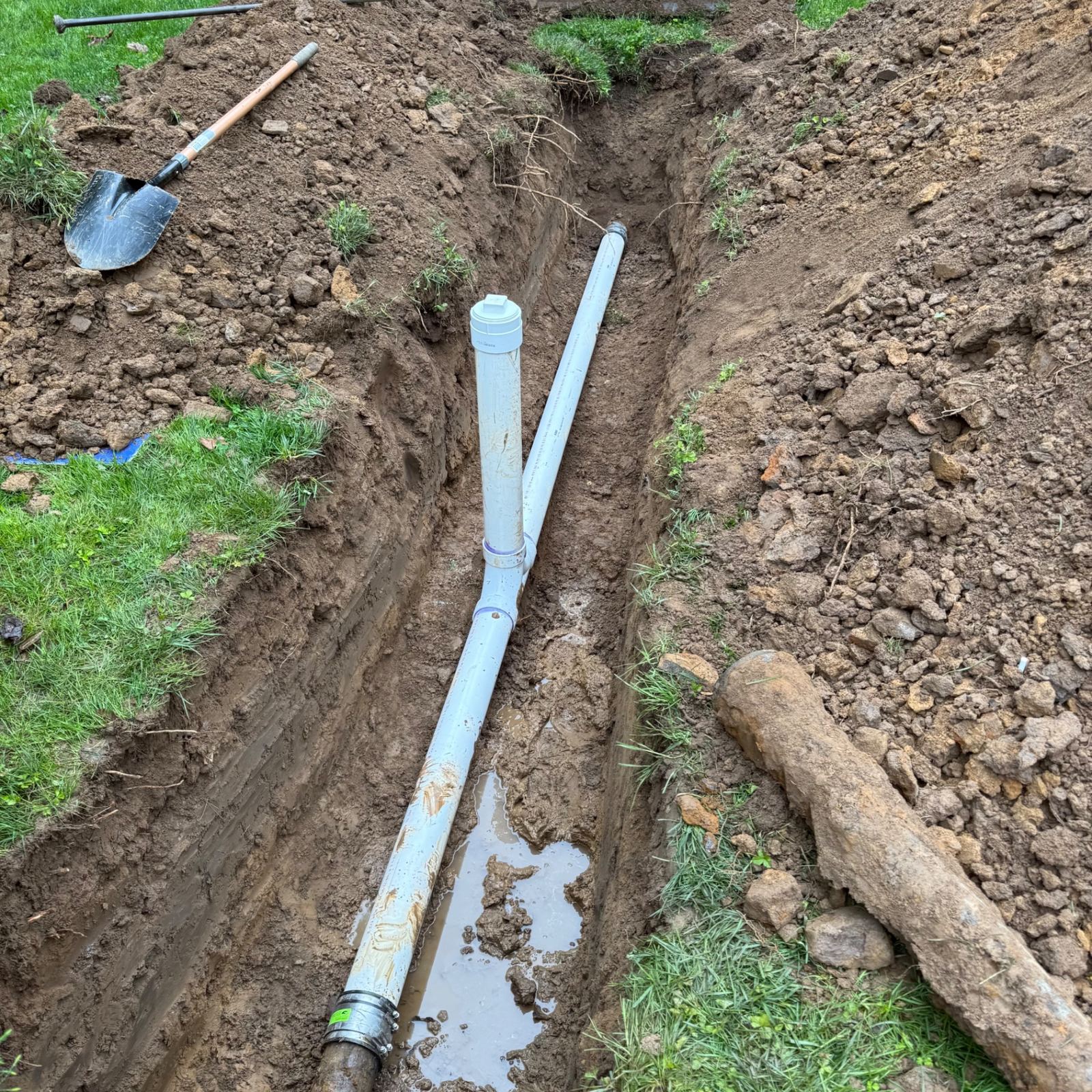
A collapse usually means replacing the failed run. Because we own our excavation equipment, we don't wait on a subcontractor to get your house back in service, and because we locate the defect before digging, the trench is as small as the job honestly allows.
Who owns the pipe — and why that matters
In most Bucks and Montgomery County townships, the homeowner owns and is responsible for the sewer lateral from the house all the way to the connection at the public main — including the part under the sidewalk, and sometimes under the street. The public main itself belongs to the township or sewer authority.
That's why the camera matters so much before you spend money. If the blockage is in your lateral, it's yours to fix and we quote it. If the backup is coming from a stopped-up public main, the camera shows exactly where your line ends and the problem begins — and you'll have footage to show the township instead of paying for a repair you didn't need.
If you suspect the main is the issue, we can still scope your lateral to prove your section is clear, and we'll tell you that plainly rather than sell you a dig.
How the diagnosis actually works
A sewer camera tells us far more than "it's clogged." We're looking at pipe material and diameter, joint condition, root intrusion and how deep it is, grease or scale thickness, standing water and where it starts, offset joints, cracks, holes, bellies, and whether the line actually reaches the main.
Then we track the camera head from above with an electronic locator, which gives us the depth and the surface position of the defect. That's the difference between a 3-foot trench at one spot and a trench down your entire front yard.
You get the video, the written findings, and the footage marks. If the line is clean and the problem was a one-time stoppage, we'll tell you that too — plenty of calls end with a cleared drain and no repair needed.
Repair or replace? How the call gets made
This is the decision homeowners ask about most, and it comes down to what the camera shows about the rest of the pipe — not how big a job we'd rather sell.
The cheapest fix that will hold is the right answer. A spot repair at one bad joint on a 1960s clay line can buy a decade. A full replacement on a line with two soft spots can save you an emergency dig in five years. We give you both prices and tell you what we'd do in your own house.
- →Jet and maintain — roots, grease, or scale in pipe that is otherwise sound and correctly sloped
- →Spot repair — one cracked, offset, or sagging section with the rest of the lateral in good shape
- →Partial replacement — several failing sections close together, or a lateral that's mostly sound
- →Full replacement — Orangeburg, a line with breaks throughout, repeated collapses, or a lateral at the end of its life
- →Replace now rather than later — you're selling, the township requires a scope, or you've had three cleanings in two years
What a sewer line repair costs — and why quotes vary
Sewer line work isn't a flat catalog price, and anyone who quotes a number sight-unseen is guessing. The cost turns on the length and depth of the run, what the pipe passes under (lawn, driveway, sidewalk, street, mature trees, a patio), the pipe material and diameter, what the township requires for permits and restoration, and whether the job is a clear, a spot repair, or a full replacement.
What we do promise: the price is on paper before work starts, based on the camera footage and a visit to your property. No open-ended dig-and-see pricing, and no add-ons that appear after the machine is already in your basement. Estimates are free.
If the camera shows a problem that cleaning can't fix, you get the footage, a plain explanation, and a written number — and you decide whether it happens now, later, or not at all.
Permits, PA One Call, and inspections
Sewer line work in most townships requires a permit and an inspection before the trench is closed, and Pennsylvania law requires buried utilities to be marked through PA One Call before any digging. Skipping either creates problems for you later — at sale time, or when a backhoe hits an unmarked gas line.
We handle the utility marking request, the permit, and the inspection scheduling as part of the job, so the work is done properly and is on the public record. That record is also an asset: proof of a new lateral raises a home's resale conversation from "what's under there?" to "here's the video and the permit."
Buying or selling a home with sewer line problems
A standard home inspection doesn't look inside the sewer line, and in neighborhoods with 1950s–1970s clay or Orangeburg laterals that's a real gap. A pre-purchase sewer scope is the cheapest due diligence on an older Bucks County house, and a pre-listing scope lets a seller control the story instead of having a buyer's surprise fall the deal.
Some townships and sewer authorities require a lateral inspection at transfer. We work with buyers, sellers, real estate agents, and property managers on exactly this — recorded video, written findings, and a fast written quote if the scope finds something, so the closing can stay on schedule.
Sewer line problems in businesses and apartments
Commercial properties fail the same ways homes do, but faster and with more people affected. A restaurant grease line can shut a kitchen during dinner service. A shared laundry room in a walk-up can flood a ground-floor unit. An office park's lateral can back up into a tenant suite nobody wants to explain.
We handle one-time stoppages and scheduled maintenance for restaurants, apartments, offices, retail, schools, and managed properties — including grease-line jetting, floor-drain service, main line scoping, and records for compliance. A scheduled jetting of a kitchen grease line costs a small fraction of one emergency backup.
How to keep a sewer line from failing
You can't stop a 60-year-old clay line from aging, but you can stop the avoidable half of the problem and see trouble coming early enough to plan for it instead of paying for it in an emergency.
- →Never pour cooking grease down any drain — wipe the pan and bin it
- →Nothing but paper and people in the toilet; "flushable" wipes are not flushable
- →Use hair catchers in every tub and shower
- →Have a usable outdoor cleanout so service is quick and cheap when you need it
- →If your line has roots, jet it on a schedule instead of waiting for the backup
- →Camera the line once before you spend on repairs — and again after, so you know it's actually clean
- →Scope the line before you buy a house, or before you list one
- →Know where your lateral runs before anyone plants a tree or builds a patio over it
When it's an emergency
Sewage backing up into the house, water rising in the basement, or a yard turning to a swamp along the pipe path can't wait until morning. Stop running water, don't flush, and call 215-364-0133 — emergency service is available.
If you can, shut off the washing machine and avoid running the dishwasher or showers until the line is cleared. Every gallon you add has to go somewhere, and with the line blocked, that somewhere is your floor.