
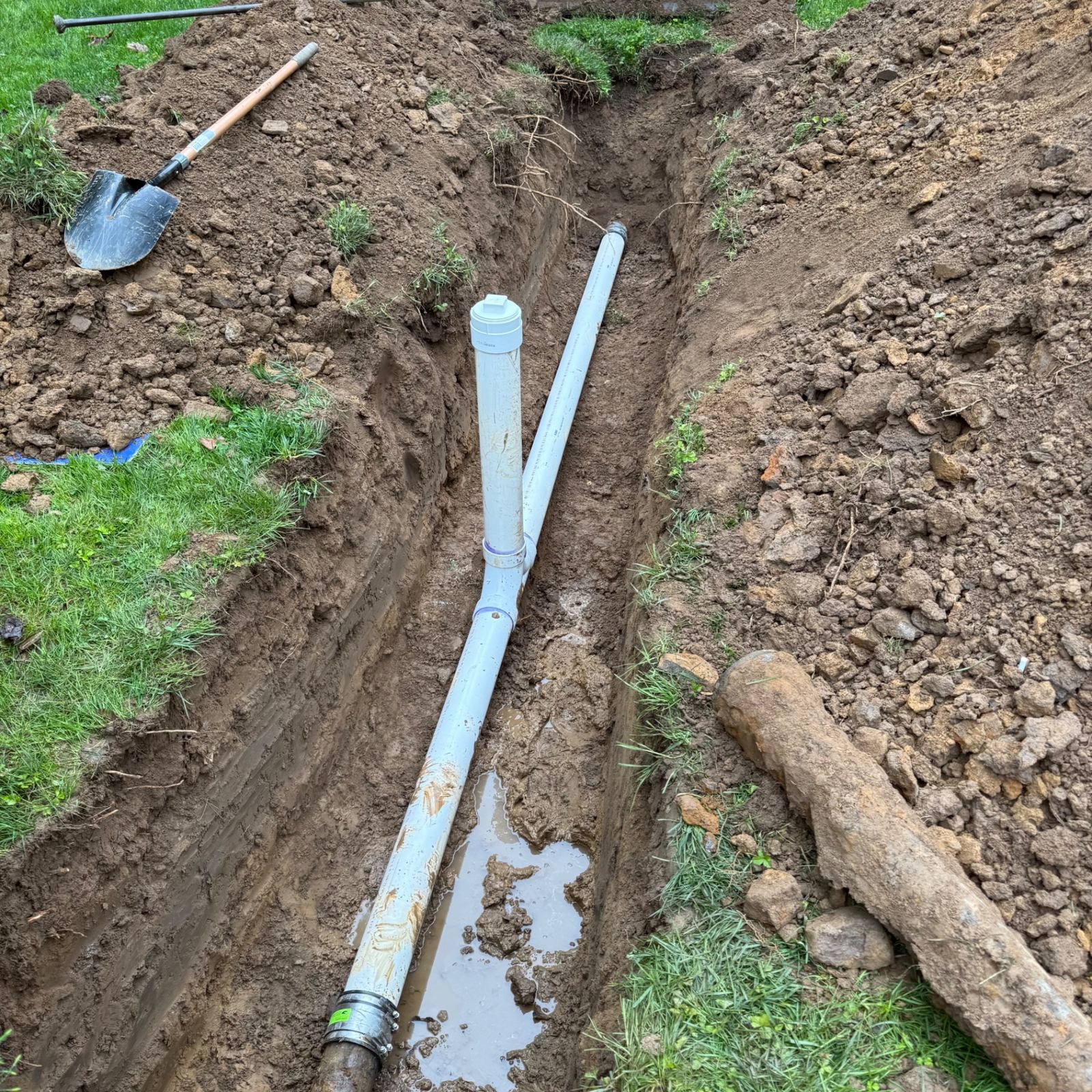
A failing sewer lateral rarely gives you one dramatic warning — it gives you a handful of small ones, spread over months or years. Homeowners who catch the pattern early replace the pipe on their schedule, at a reasonable price, without sewage on the basement floor. Homeowners who miss the pattern usually meet us for the first time at 2 a.m.
After 40+ years of scoping and replacing sewer lines from Southampton to Doylestown, here are the seven signs that mean it's time for a camera inspection — and often full sewer line replacement.
Seeing one or more of these signs?
Book a diagnostic camera inspection and get a written report with pipe material, defects, and repair options — before the next backup.
1. Repeated Sewage Backups in Multiple Drains
If your lowest-level toilet, tub, or floor drain backs up more than once — especially when you run laundry or a shower — the blockage is downstream of every fixture, in the main sewer lateral. A single-fixture clog is a drain problem. Multiple fixtures backing up simultaneously is almost always a main-line problem, and if snaking or jetting the line only buys you a few months of relief, the pipe itself is failing.
2. Slow Drains Across the Whole House
One slow sink is a local clog. Every sink, tub, and toilet draining sluggishly at the same time means restricted flow in the main lateral — usually from root mass, a belly (low spot) holding sludge, or a partially collapsed pipe. A camera scope tells you which.
3. Foul Sewer Odors Inside or Around the House
Healthy sewer laterals are sealed. If you smell sewer gas in the basement, near a floor drain, or in the yard along the line's path, the pipe is cracked, offset at a joint, or the vent stack has failed. Cracked underground pipe leaks both wastewater into the soil and odors up into the home.
4. Patches of Extra-Green Grass, Sinkholes, or Soggy Spots in the Yard
A leaking sewer lateral fertilizes the lawn directly above it. Homeowners often notice a strip of unusually lush, dark-green grass running from the foundation toward the street. In more advanced failures, the soil washes into the broken pipe and you get a depression, soft spot, or outright sinkhole above the line. Both are late-stage warnings.
5. Roots in the Line (Especially Recurring After Cleanings)
Every clay tile joint, cast iron crack, and Orangeburg seam is an invitation for maple, willow, and oak roots — which are everywhere in Bucks County. We can jet or auger the roots out, but if you're on an annual root-clearing schedule, the pipe is telling you it's time. Modern PVC or lined pipe has watertight joints roots cannot penetrate.
6. Foundation Cracks, Wet Basement, or Mold Along the Sewer Run
A slow sewer leak under a slab or crawl space undermines the soil supporting your foundation. Look for new cracks in basement walls or floors, efflorescence (white mineral staining), musty smells, or unexplained mold — especially along the path of the sewer lateral from the stack to the exterior wall.
7. Age and Pipe Material — Orangeburg, Old Clay, or Rusted Cast Iron
If your home was built before 1980, the odds are high you have clay, cast iron, or Orangeburg underground. All three have a service life, and most Bucks County laterals of that era are at or past it. A one-time diagnostic camera scope tells you what you have and how much life is left — before a backup makes the decision for you.
Repair or Replace? How We Decide
Not every failing sewer line needs full replacement. A camera scope answers three questions: what is the pipe made of, where are the defects, and how much of the line is affected?
- Clear with cleaning: If the pipe itself is sound and the issue is roots or grease, hydro jetting often restores full flow and buys years.
- Spot repair: A single cracked joint or offset in an otherwise good line — dig one small pit and replace that section.
- Full replacement: Orangeburg, deformed pipe, widespread channeling in cast iron, multiple bellies, or repeated failures at different points along the run. In these cases, a full sewer line replacement — traditional or trenchless — is the right long-term answer.
Traditional Excavation vs. Trenchless Replacement
Traditional excavation trenches the length of the line — proven, thorough, and required when the line has severe bellies or is being re-graded. Trenchless methods (pipe bursting and cured-in-place lining) install new pipe through the existing path with only two access pits, preserving driveways, patios, and mature landscaping. Suitability depends on pipe condition, depth, and route. We tell you honestly which method fits your line during the diagnostic scope.
Don't Wait for the Backup
A planned sewer line replacement is a routine job. An emergency replacement — after raw sewage has already backed up into a finished basement — is a job plus restoration, remediation, and days of disruption. The difference is a camera scope. If you're seeing two or more of the signs above, book the inspection now, on your schedule, while the pipe is still standing.
Ready to find out what's underground?
Same-day and next-day appointments across Bucks & Montgomery County. Free estimates on replacement quotes.
- Sewer Line Replacement — service details & process
- Sewer Lateral Inspection — camera scope with written report
- Sewer Jetting & Drain Cleaning — when the pipe is still sound
- Pre-Listing Sewer Inspections — selling your home guide
- Hydro Jetting vs Snaking — related guide
Frequently Asked Questions
How do I know if my sewer line needs to be replaced or just repaired?+
The only way to know for sure is a camera inspection. Isolated cracks, small offsets, and root intrusion in an otherwise sound pipe can often be spot-repaired or cleared with hydro jetting. Widespread channeling in cast iron, deformed or collapsed Orangeburg, or repeated backups across multiple sections of the line usually mean full sewer line replacement is the right call.
How much does sewer line replacement cost in Bucks County, PA?+
Residential sewer line replacement in Bucks and Montgomery County typically runs $8,000–$25,000 depending on depth, length, pipe material, and whether traditional excavation or trenchless methods are used. Call 215-364-0133 for a written estimate — every property is different and we quote after a camera inspection, not before.
How long does a sewer line replacement take?+
Most residential sewer lateral replacements are completed in 1–3 days once permits are pulled. Trenchless methods (pipe bursting, cured-in-place liner) are usually faster and disturb less of the yard than open excavation. Your home remains occupied — you just avoid running water for the few hours the line is disconnected.
How long do sewer lines last?+
It depends on the pipe material. PVC is rated 50–100+ years. Cast iron typically lasts 50–75 years before channeling. Clay tile with mortar joints often makes it 50–60 years before roots overwhelm the joints. Orangeburg (bituminized fiber conduit installed from roughly 1945–1972) usually fails in 30–50 years — and most of what we find is already past that mark.
Do you offer trenchless sewer line replacement?+
Yes, when the existing line and site conditions are suitable. Trenchless replacement uses pipe bursting or lining to install new pipe with minimal digging — great for preserving driveways, mature landscaping, and hardscape. We assess suitability during the camera inspection.
Can I keep using my plumbing during the replacement?+
You can use fixtures normally until the day we disconnect the old lateral. During the actual replacement, we ask you to avoid heavy water use for a few hours. Most homeowners plan around it easily.
Do I need a permit to replace my sewer line?+
Yes. Sewer lateral work in Bucks and Montgomery County requires a township permit and often coordination with the municipal sewer authority. We pull the permit, schedule inspections, and handle the paperwork as part of the job.